
Choosing between the top CDN providers can be difficult because, on paper, most offer very similar things. This comparison looks at some of the best CDN companies: Cloudflare, CloudFront, Akamai, Fastly, Bunny.net, Google Cloud CDN, Azure Front Door, and FlashEdge. We'll compare them across performance, security, pricing, developer experience, and common workloads. You'll see which providers fit SaaS, streaming, ecommerce, APIs, gaming, startups, and enterprise deployments.
Quick Summary
- The biggest CDN providers offer many of the same services, but their pricing, network coverage, caching capabilities, and performance can vary significantly.
- Content delivery network companies all provide stats on their websites but it's more important to look at how those numbers translate to performance for your specific users and workloads.
- The top 10 CDN providers can't be directly compared because they use different pricing models, feature sets, network architectures, and approaches to caching and security.
Why Choosing the Right CDN Provider Matters More Than Ever
Modern applications route sensitive traffic through the same network layer that used to only cache static images, and when it comes to load times, modern users are more discerning than ever. As a result, a CDN is no longer just an option for many enterprises.
Three big shifts are the core of this change:
- Edge computing has moved logic like authentication checks and personalization out of origin servers and onto edge nodes, so the CDN provider is now part of the application architecture.
- AI-driven applications generate unpredictable, bursty traffic that stresses older flat-rate bandwidth models built for steady web traffic.
- Security has merged with delivery. DDoS protection, bot management, and WAFs now sit at the same layer as caching, so a CDN decision is also a security decision.
To choose between the top CDN providers today we need to weigh all three of these factors together. When people search for CDN network providers, they are usually comparing this kind of trade-off: the reach of the CDN versus architectural fit.
CDN Comparison Criteria: How We Evaluated the Best CDN Providers
Every provider in this comparison was scored against eight criteria that map directly to what a technical buyer needs to know before signing a contract.
- Performance and latency: how quickly content reaches the end user, measured by time to first byte and cache hit ratio.
- Global PoP coverage: the number and distribution of points of presence, and how that maps to your actual user base rather than a marketing map.
- Security capabilities: DDoS mitigation, WAF, bot management, and TLS handling.
- Pricing transparency: whether the published rate reflects what you actually pay once requests, origin shield, and add-ons are included.
- Ease of deployment: how much engineering time it takes to go from signup to production traffic.
- Developer experience: API quality, configuration language, documentation, and how painful it is to onboard a new engineer.
- Analytics and observability: real-time logging, dashboards, and how much visibility you get into cache performance without paying extra.
- Scalability: how the platform behaves when traffic jumps tenfold overnight, and whether that requires a phone call to sales.
Top CDN Providers Compared: Full CDN Comparison Table
The table below lines up the top CDN providers side by side across the criteria that matter most for a technical evaluation. Use this CDN providers comparison as your shortlist, then test the two or three closest matches against your own traffic before signing anything.
| Provider | Best For | Global Network | Security | Streaming | Pricing Model | Ease of Use | Enterprise Readiness |
|---|---|---|---|---|---|---|---|
| Cloudflare | Startups to enterprise wanting one platform | 330+ cities, 120+ countries | WAF, DDoS, bot management on paid plans | Limited, not a specialist | Flat-rate tiers, mostly unmetered bandwidth | Very high | High |
| Amazon CloudFront | AWS-native workloads | 700+ points of presence | AWS WAF, Shield, bot control add-on | Strong with AWS media tooling | Pay-as-you-go or flat-rate plans | Moderate, AWS console required | High |
| Akamai | Large enterprise, broadcast-scale media | 4,100+ PoPs in 135+ countries | Enterprise-grade WAF, DDoS, bot management | Industry leading | Custom enterprise contracts | Complex, needs dedicated admin | Very high |
| Fastly | Developer teams needing real-time control | Fewer, high-capacity PoPs | Next-gen WAF, DDoS | Strong, real-time capable | Usage-based plus platform fee | High for experienced teams | High |
| Bunny.net | Startups and budget-conscious teams | 100+ PoPs | Basic WAF, shield add-ons | Purpose-built stream product | Pay-as-you-go, low per-GB rate | Very high | Moderate |
| Google Cloud CDN | Teams already running on Google Cloud | Google's global backbone | Cloud Armor WAF and DDoS | Moderate | Usage-based, tiered by network tier | Moderate, GCP knowledge required | High |
| Azure Front Door | Microsoft-centric enterprises | Microsoft's global edge network | Built-in WAF, DDoS protection | Moderate | Usage-based, Standard or Premium tiers | Moderate | High |
| FlashEdge | SaaS and mid-market teams wanting predictable pricing with hands-on support | Global PoP footprint, expanding | DDoS protection and WAF included as standard | Solid for standard delivery | Transparent usage-based pricing | High | Growing, strong fit for mid-market |
The best CDN services for your needs depend on real-world comparisons, so remember it's best to take this table as a starting point and not a final decision-making tool.
Top CDN Companies Reviewed in Detail
Choosing the right CDN provider depends on your workload; feature checklists alone aren't enough to compare CDNs. Here is what each does well, and where each falls short:
Cloudflare
Best for teams that want CDN, DNS, WAF, and DDoS protection in one platform, from startups to large enterprises. Strong performance and security even on lower tiers, with a free plan solid enough for production. Not built for heavy video, and costs get less predictable with add-ons. Fits marketing sites, SaaS, ecommerce, and APIs. Choose it for an all-in-one vendor; skip it for video-heavy workloads.
- Pricing model: Free plan, then flat-rate Pro/Business, custom Enterprise.
- Notable features: WAF + DDoS on all paid plans, unmetered HTTP bandwidth.
Amazon CloudFront
Best for teams already running on AWS. Deep native integration and favorable origin-transfer economics for AWS-origin setups. Billing is complex, splitting across bandwidth, requests, and features, and security isn't included in the base price. Fits S3-hosted sites and AWS-hosted apps. Choose it if your infrastructure lives on AWS; skip it otherwise.
- Pricing model: Usage-based; bandwidth, requests, and features bill separately.
- Notable features: CloudFront Functions, Lambda@Edge, Route 53/AWS WAF integration.
Akamai
Best for Fortune 500s, media giants, and enterprises with strict compliance needs. Largest network footprint of any CDN, with deep ISP-level peering. No self-serve pricing, and the console usually needs a dedicated admin. Fits live broadcast, OTT video, and large-scale ecommerce. Choose it when network depth matters more than simplicity; skip it without admin resources.
- Pricing model: Custom enterprise contracts; no published per-GB rate.
- Notable features: EdgeWorkers for edge logic, adaptive media delivery.
Fastly
Best for dev teams that need real-time cache control. Sub-second global purging and genuine WebAssembly edge compute. No free tier, pricier bandwidth, and a configuration language with a learning curve. Fits real-time APIs, news/media, and custom edge logic. Choose it for programmable edge and instant purge; skip it if you want simple, low-cost delivery.
- Pricing model: Usage-based delivery, separate flat-rate network add-ons.
- Notable features: Instant Purge, Compute (WebAssembly), next-gen WAF.
Bunny.net
Best for startups, WordPress sites, and budget-conscious teams. Very low per-GB rates, a clean dashboard, and a dedicated video streaming product. Security tooling is lighter, and PoP coverage is smaller than the hyperscalers. Fits WordPress/static sites and indie streaming. Choose it for low-cost, predictable delivery; skip it if compliance is non-negotiable.
- Pricing model: Pay-as-you-go, low minimum, per-GB rates scale down.
- Notable features: Bunny Stream, simple API, transparent pricing.
Google Cloud CDN
Best for teams running on Compute Engine or GKE. Runs on Google's own infrastructure with one-step setup once load balancing is in place, plus Cloud Armor for security. Pricing spans data transfer, cache, and requests, and value drops outside Google Cloud. Fits GKE/Compute Engine apps. Choose it if you're already on Google Cloud; skip it for multi-cloud setups.
- Pricing model: Usage-based, tiered by network class.
- Notable features: Cloud Load Balancing integration, committed-use discounts.
Azure Front Door
Best for organizations standardized on Azure and Microsoft's stack. Native Azure DevOps/Active Directory integration, with WAF and DDoS included, and now Microsoft's recommended path over classic Azure CDN. Legacy CDN users face a migration, and media tooling is less mature. Fits enterprise Azure apps and AD-tied tools. Choose it if you're on Azure; skip it for best-in-class streaming.
- Pricing model: Tiered; base fee plus request/data charges.
- Notable features: Unified WAF/load balancing, managed migration tooling.
FlashEdge
Best for mid-market SaaS teams that want predictable pricing and direct support. Transparent, usage-based pricing with WAF and DDoS included as standard, plus no traffic charges to AWS. PoP coverage is smaller than the largest providers. Fits mid-market SaaS and AWS-adjacent apps. Choose it for security included as standard; skip it if you need the largest possible footprint.
- Pricing model: Transparent, usage-based; security included in the base rate.
- Notable features: WAF, DDoS, direct support, advanced analytics.
Best CDN Providers by Use Case: SaaS, Streaming, Ecommerce, and More
Global CDN providers define "global" differently, and the best fit changes once you factor in your actual workload.
- SaaS: SaaS platforms prioritize low-latency API and application delivery over the massive throughput video requires. Cloudflare and FlashEdge both fit well, with FlashEdge often winning on pricing predictability for mid-market teams.
- Streaming: Video-heavy workloads reward specialist infrastructure. Akamai leads at broadcast scale, and Fastly handles live-event delivery well.
- Ecommerce: Ecommerce needs fast, secure delivery of product images and checkout flows, plus bot protection during sales spikes. Cloudflare handles this well, and FlashEdge suits mid-market storefronts that want included security.
- APIs: API-heavy architectures benefit from edge computing and fine cache control, since cache keys must weigh headers, cookies, and query strings to decide which responses can safely be reused. Fastly's Compute platform and Cloudflare Workers both stand out for dynamic, per-request logic.
- Gaming: Game distribution needs to move large patch files globally, fast. Akamai and Bunny.net sit at opposite ends of the budget spectrum.
- Startups: Early-stage teams should prioritize a real free tier and fast setup over enterprise feature depth. Cloudflare's free plan and Bunny.net's low-commitment pricing both make sense here.
- Enterprise: Large organizations weigh compliance, dedicated support, and network depth heavily. Akamai remains the default for demanding, compliance-heavy deployments, with Cloudflare Enterprise as a strong alternative.
How to Choose the Right Content Delivery Network Provider
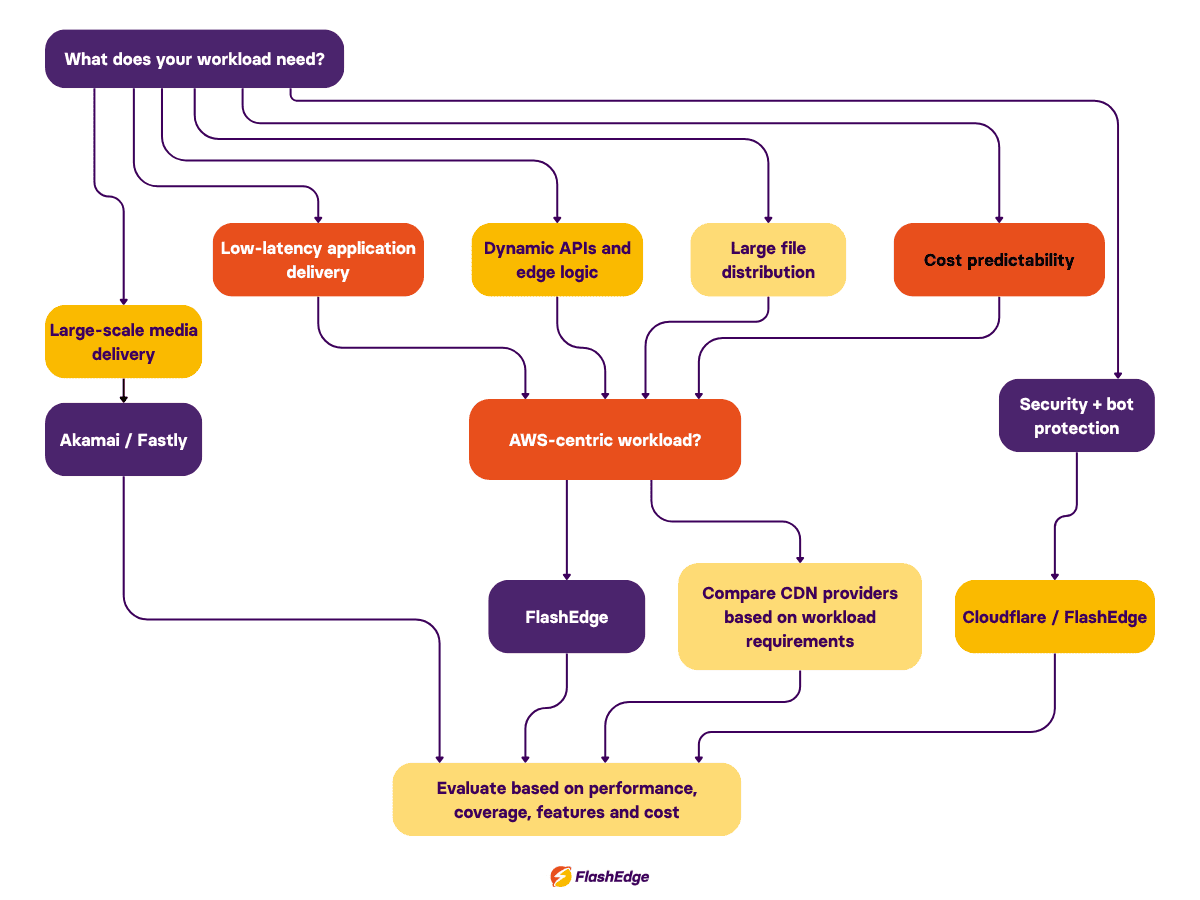
There is no single best CDN provider. There is only the best CDN provider for your architecture, budget, and team. Work through these questions in order before comparing quotes.
- Where do your users actually live? Pull real analytics data, then check each candidate's PoP coverage in those specific regions.
- What does your traffic mix look like? Mostly static HTML and images have very different requirements than an API-heavy application or a video platform.
- How much security do you need built in? If DDoS protection, a WAF, and bot management need to be included rather than billed separately, that narrows the field quickly.
- How predictable does your bill need to be? Usage-based pricing rewards steady traffic; flat-rate plans reward unpredictable or bursty traffic.
- Who is going to operate this day to day? A platform needing a dedicated administrator is a different commitment than one an engineer can configure in an afternoon.
- What happens when you outgrow your current tier? Check the path to the next tier before you need it, not after a traffic spike forces the conversation.
Remember that published benchmarks and comparison tables, including the one above, are a starting point for narrowing the field of content delivery network providers, not a substitute for testing against your own workload.
Get Started With FlashEdge
Choosing among content delivery network providers is a question of fit, not fame. FlashEdge is worth considering for AWS-based SaaS and mid-market workloads where predictable pricing, straightforward setup, direct support, and included security matter. Its performance is comparable with major AWS CDN services, while traffic between FlashEdge and AWS services is not charged. Enterprise customers can also get statistics tailored to their requirements, with image optimization features coming soon. Talk to one of our engineers or try a free trial to see how FlashEdge can work for your enterprise.
Frequently Asked Questions
What is the difference between a CDN and a web host?
A web host stores and serves your origin content from one location. A CDN copies that content to servers around the world so users load it from a nearby point of presence, cutting latency and origin load.
Which CDN provider is cheapest?
On raw per-gigabyte rate, budget-focused providers like Bunny.net tend to come in lowest, and Cloudflare's unmetered model can be effectively free for cache-heavy sites. Total cost depends on your traffic mix and which security features are included rather than billed separately.
Do I need a CDN if I already use a cloud provider?
Most cloud providers offer their own CDN add-on, often the simplest path if your infrastructure already lives there. Some teams still choose a third-party CDN for broader coverage or to avoid concentrating infrastructure with one vendor.
Can I use more than one CDN provider at the same time?
Yes. Multi-CDN setups are increasingly common, often pairing a security-focused platform for WAF and DNS with a bandwidth-optimized provider for heavy media delivery.